
Article
“It's the first time in my career that I am encouraging my clients to consume less of my service!” - Claire Gerbaud Ndomba is Director of Marketing, Data, and Communication at Engie. _No Bullshit - a shot of inspiration highlighting (good) examples from the brands of tomorrow!
Label
Label
No bullshit
No bullshit

Today, I am the marketing, data, and communication director for the B2C division of ENGIE. My career spans nearly 25 years. If I look at the whole picture and identify the common thread, it has always been the customer in the service sector.
I started at SFR working in marketing, customer relations, and communication. When I left, I was the brand director and managed a wide variety of topics. I like to say that I arrived to launch SMS on prepaid plans and left while launching TV channels. That gives you an idea of the variety of the work.
Next, I worked for a year in publishing at France Loisirs, and then I went freelance, focusing on brand strategy. Over the last four years, before joining ENGIE, I was the communications director for the Brie Picardie regional bank at Crédit Agricole, covering all aspects of customer communication, corporate communication, financial communication, and employer brand. A year and a half ago, I joined ENGIE to lead a variety of projects: marketing, offer creation, customer engagement, data, and communication.
Indeed, when you look at the 3 major sectors I've worked in (telecoms, banking, energy), they are all service-related, with a key characteristic being that we place people in front of our customers. That is what makes the difference. We are not dealing with a product that we release, which is standardized, like a tube of toothpaste. That's what is interesting. The human experience. In the service industry, the question that arises is "how do I work back from my customer insight to create a memorable experience?".
Unlike other service sectors such as entertainment (restaurants, travel, leisure...), which sit at the top of what I call the 'joy scale' (the joy we feel when spending money: we are happy to buy a trip, but paying for insurance brings less joy), energy, banking, and telecommunications occupy a lower place on this scale. From a marketing perspective, this poses a real question: what ingredients allow me to move back up this joy scale? How do I differentiate myself? What, in the experience I am going to offer my customer, will make the difference?
When thinking about the service sector, the cross-cutting element is always the experience. One of the key elements is that for the customer to feel good with us and want to stay with us, we must offer them the best possible experience.
That works out well since we have been recognized as such. Within the energy sector, we offer the best customer experience in France. We were indeed voted Customer Service of the Year. Furthermore, this is not the first year we have received this award. How did we do it? By improving the customer experience across all the touchpoints we have with our customers: with our customer advisors, during the digital journey, throughout the entire relationship. It is also because, throughout the experience we offer our customers, we remain aligned with our brand DNA: making the energy transition simple, desirable, and affordable.
One of my biggest surprises when arriving in this energy market was the weight of regulation. This regulation is important because it provides a framework in a sector where the value chain is complicated (production, transport, storage, etc.) and where the players are diverse (CRE, MNE, etc.). However, this also brings many constraints. Fortunately, that is also where creativity is born. Ultimately, this forces us to think about our marketing differently. It also positions us to simplify information to make it easily understandable for our customers. Finally, at ENGIE, we were keen to differentiate ourselves through commitment by offering our customers green electricity, while also giving them the opportunity to get more involved through our program 'Mon Programme pour Agir'.
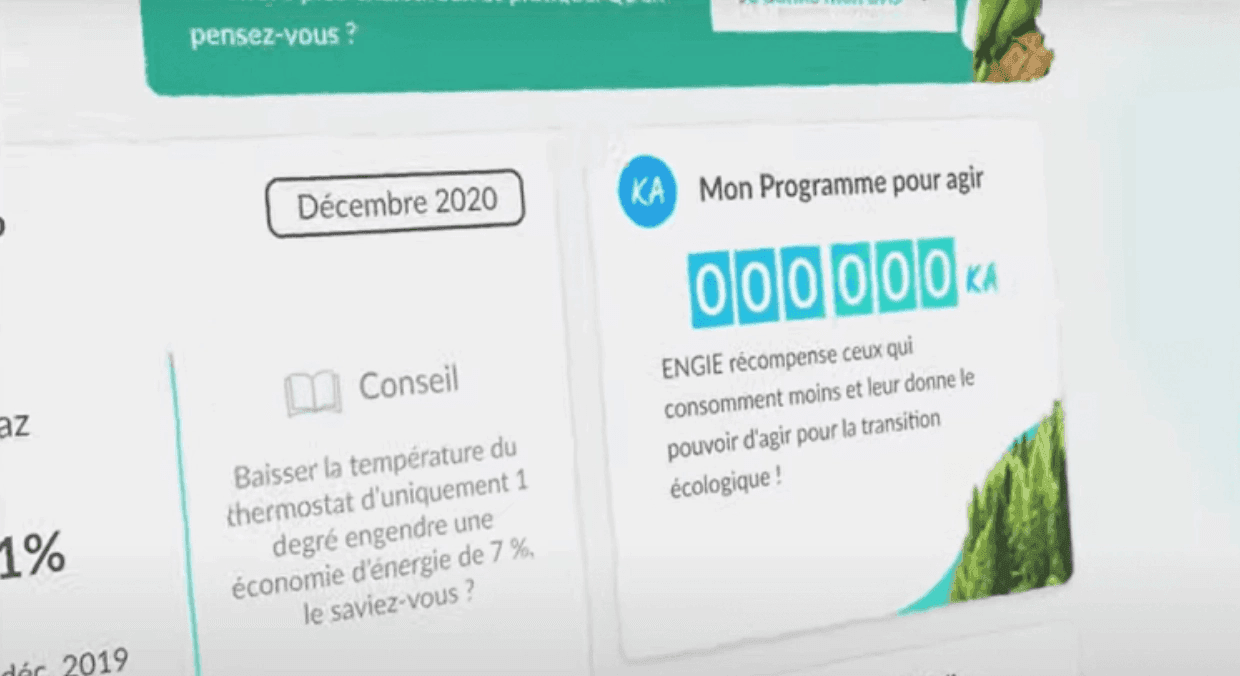
It is one of the first engagement programs that aims to encourage customers to practice energy sobriety and consume less. The reason? At ENGIE, we are convinced that we are part of the solution, that progress is possible if we all work together, and that this is not in opposition to growth. On the contrary, we can achieve decarbonized, smart growth by bringing our stakeholders—namely our customers—on board. In other words? It's about raising awareness, energy transition, and civic action. This program was designed for that: helping our customers consume less and consume better.
In terms of climate change, the French have a rather ambivalent stance. That is to say, it ranges from "it's great, but then it shouldn't cost me more" to "I am highly committed and ready to make real changes in my lifestyle." Our role as a provider is to support all of these customers with simple actions that will not only allow them to better understand several issues but also to put energy-saving tips into practice.
We allow our customers to access a wide range of content: articles, podcasts, quizzes, energy-saving challenges... And it works very well! In 2024, more than 500,000 customers participated in energy challenges, showing very strong growth (over 70%) compared to last year. We also offer more engaging actions (replacing appliances with less energy-consuming products, installing heat pumps or photovoltaic panels, carrying out a complete carbon footprint assessment, etc.). Our entire program is based on a fun and positive approach. In our view, for it to work, energy transition topics also need to be perceived as cool. We don't want to live in a kind of end-of-the-world anxiety. On the contrary. We want to be able to say to ourselves that solutions exist and that we can all play a part.
The first impact is that this program sparks interest and engages people. That is the key indicator for us. One million customers took part in 2024. As mentioned earlier, this program requires active participation. Moreover, no registration is required: as soon as you have a customer account, the program is accessible in 1 click. The fact that customers are truly engaging shows that it meets a real demand.
The second point is that we observe that highly motivated customers are likewise... ambassadors! Put another way, the customers who are active in this engagement program are also those who have the best image of and highest satisfaction with ENGIE. They are the ones most likely to speak positively about ENGIE as a provider. They have the best understanding of what ENGIE does. This means over a million customers are ready to recommend us!
The first indicator is active customer participation. This is what confirms we are heading in the right direction. The second indicator is participation in energy challenges and the associated results (particularly in terms of CO2 reduction). This shows that every action counts, helps move towards mindful consumption, and rewards customers. We want the customer to benefit. This program also allows them to save money, which has been particularly important given the economic climate of recent years (inflation, energy prices, etc.). And this works perfectly, since it aligns with the goals of the energy transition. Everyone's interests align.
Energy is not a product like any other. There are products you can do without, but when you are forced to do without energy, it is called fuel poverty. At ENGIE, we are dedicated to ensuring that our customers facing financial difficulties do not fall into fuel poverty. We have many initiatives in place to protect them. For example, we recently decided to pay an additional 50 euros to all energy voucher holders with ENGIE. This might seem minor, but on the scale of ENGIE, it is a significant gesture. It represents nearly 35 million euros.
We also contribute 6 million euros annually to the Housing Solidarity Fund (Fonds de solidarité logement). This year, we doubled that amount, increasing it to 12 million euros. This fund is then used by local departments which, in turn, redistribute it to associations that assist individuals (either with energy renovation projects or simply to help customers pay their energy bills).
When looking at the energy market, we see a colossal exposure to advertising messages. All market players communicate heavily, making the environment particularly saturated. For us, the challenge is twofold: maintaining sufficient visibility and keeping message consistency. Since this engagement program is a key differentiator, it is a very interesting communication territory to explore. Furthermore, beyond brand awareness metrics, it is the positioning metrics that interest us the most. Are we identified as a supporter in the energy transition? Are we recognized for helping customers save energy? In our view, that is what ultimately builds the brand's value.
We wanted to create a common thread that would embody our value proposition. That's how the proposal and the idea of having our narrator came to life. The narrator represents the questions that customers might have about the energy world. It's a brand stance that we call human-centric. We position ourselves alongside our customers. He is not a celebrity sponsor. And it works. ENGIE has long had the best ad recall in the market. In concrete terms, when I show energy sector ads to customers with the brand removed and ask "do you know who made this ad?", we are far ahead with 80% recall. When you spend €1 on advertising, you want to make sure you are recognized as the advertiser, otherwise it is pointless. This was one of the strong elements we wanted to reinforce. That's why we wanted to create this common thread.
There are several things. First, when we say we want to involve our customers (who are using their points to support projects in higher numbers than ever), it is equally essential to give them updates on these projects. In other words? They earn points through the program, which ENGIE converts into euros to fund projects. That's great, and we want to share what happens next. It shouldn't stop there. We are looking at solutions to provide them with updates over the long term, so they can see the results of their actions.
Second, we want to continue encouraging them to consume better and less. More specifically? We want to personalize the experience even further. This has already started thanks to the use of artificial intelligence, which is a very effective lever. We have laid the first foundation stone, and now we want to go further. The next step will be to adapt advice based on everyone's individual situation (housing, location, etc.).
I would say Maud Caillaux from Green Got. I like her approach to the financial world. I also like her way of sharing her convictions and her entrepreneurial perspective; it's very informative.
Today, I am the marketing, data, and communication director for the B2C division of ENGIE. My career spans nearly 25 years. If I look at the whole picture and identify the common thread, it has always been the customer in the service sector.
I started at SFR working in marketing, customer relations, and communication. When I left, I was the brand director and managed a wide variety of topics. I like to say that I arrived to launch SMS on prepaid plans and left while launching TV channels. That gives you an idea of the variety of the work.
Next, I worked for a year in publishing at France Loisirs, and then I went freelance, focusing on brand strategy. Over the last four years, before joining ENGIE, I was the communications director for the Brie Picardie regional bank at Crédit Agricole, covering all aspects of customer communication, corporate communication, financial communication, and employer brand. A year and a half ago, I joined ENGIE to lead a variety of projects: marketing, offer creation, customer engagement, data, and communication.
Indeed, when you look at the 3 major sectors I've worked in (telecoms, banking, energy), they are all service-related, with a key characteristic being that we place people in front of our customers. That is what makes the difference. We are not dealing with a product that we release, which is standardized, like a tube of toothpaste. That's what is interesting. The human experience. In the service industry, the question that arises is "how do I work back from my customer insight to create a memorable experience?".
Unlike other service sectors such as entertainment (restaurants, travel, leisure...), which sit at the top of what I call the 'joy scale' (the joy we feel when spending money: we are happy to buy a trip, but paying for insurance brings less joy), energy, banking, and telecommunications occupy a lower place on this scale. From a marketing perspective, this poses a real question: what ingredients allow me to move back up this joy scale? How do I differentiate myself? What, in the experience I am going to offer my customer, will make the difference?
When thinking about the service sector, the cross-cutting element is always the experience. One of the key elements is that for the customer to feel good with us and want to stay with us, we must offer them the best possible experience.
That works out well since we have been recognized as such. Within the energy sector, we offer the best customer experience in France. We were indeed voted Customer Service of the Year. Furthermore, this is not the first year we have received this award. How did we do it? By improving the customer experience across all the touchpoints we have with our customers: with our customer advisors, during the digital journey, throughout the entire relationship. It is also because, throughout the experience we offer our customers, we remain aligned with our brand DNA: making the energy transition simple, desirable, and affordable.
One of my biggest surprises when arriving in this energy market was the weight of regulation. This regulation is important because it provides a framework in a sector where the value chain is complicated (production, transport, storage, etc.) and where the players are diverse (CRE, MNE, etc.). However, this also brings many constraints. Fortunately, that is also where creativity is born. Ultimately, this forces us to think about our marketing differently. It also positions us to simplify information to make it easily understandable for our customers. Finally, at ENGIE, we were keen to differentiate ourselves through commitment by offering our customers green electricity, while also giving them the opportunity to get more involved through our program 'Mon Programme pour Agir'.
It is one of the first engagement programs that aims to encourage customers to practice energy sobriety and consume less. The reason? At ENGIE, we are convinced that we are part of the solution, that progress is possible if we all work together, and that this is not in opposition to growth. On the contrary, we can achieve decarbonized, smart growth by bringing our stakeholders—namely our customers—on board. In other words? It's about raising awareness, energy transition, and civic action. This program was designed for that: helping our customers consume less and consume better.
In terms of climate change, the French have a rather ambivalent stance. That is to say, it ranges from "it's great, but then it shouldn't cost me more" to "I am highly committed and ready to make real changes in my lifestyle." Our role as a provider is to support all of these customers with simple actions that will not only allow them to better understand several issues but also to put energy-saving tips into practice.
We allow our customers to access a wide range of content: articles, podcasts, quizzes, energy-saving challenges... And it works very well! In 2024, more than 500,000 customers participated in energy challenges, showing very strong growth (over 70%) compared to last year. We also offer more engaging actions (replacing appliances with less energy-consuming products, installing heat pumps or photovoltaic panels, carrying out a complete carbon footprint assessment, etc.). Our entire program is based on a fun and positive approach. In our view, for it to work, energy transition topics also need to be perceived as cool. We don't want to live in a kind of end-of-the-world anxiety. On the contrary. We want to be able to say to ourselves that solutions exist and that we can all play a part.
The first impact is that this program sparks interest and engages people. That is the key indicator for us. One million customers took part in 2024. As mentioned earlier, this program requires active participation. Moreover, no registration is required: as soon as you have a customer account, the program is accessible in 1 click. The fact that customers are truly engaging shows that it meets a real demand.
The second point is that we observe that highly motivated customers are likewise... ambassadors! Put another way, the customers who are active in this engagement program are also those who have the best image of and highest satisfaction with ENGIE. They are the ones most likely to speak positively about ENGIE as a provider. They have the best understanding of what ENGIE does. This means over a million customers are ready to recommend us!
The first indicator is active customer participation. This is what confirms we are heading in the right direction. The second indicator is participation in energy challenges and the associated results (particularly in terms of CO2 reduction). This shows that every action counts, helps move towards mindful consumption, and rewards customers. We want the customer to benefit. This program also allows them to save money, which has been particularly important given the economic climate of recent years (inflation, energy prices, etc.). And this works perfectly, since it aligns with the goals of the energy transition. Everyone's interests align.
Energy is not a product like any other. There are products you can do without, but when you are forced to do without energy, it is called fuel poverty. At ENGIE, we are dedicated to ensuring that our customers facing financial difficulties do not fall into fuel poverty. We have many initiatives in place to protect them. For example, we recently decided to pay an additional 50 euros to all energy voucher holders with ENGIE. This might seem minor, but on the scale of ENGIE, it is a significant gesture. It represents nearly 35 million euros.
We also contribute 6 million euros annually to the Housing Solidarity Fund (Fonds de solidarité logement). This year, we doubled that amount, increasing it to 12 million euros. This fund is then used by local departments which, in turn, redistribute it to associations that assist individuals (either with energy renovation projects or simply to help customers pay their energy bills).
When looking at the energy market, we see a colossal exposure to advertising messages. All market players communicate heavily, making the environment particularly saturated. For us, the challenge is twofold: maintaining sufficient visibility and keeping message consistency. Since this engagement program is a key differentiator, it is a very interesting communication territory to explore. Furthermore, beyond brand awareness metrics, it is the positioning metrics that interest us the most. Are we identified as a supporter in the energy transition? Are we recognized for helping customers save energy? In our view, that is what ultimately builds the brand's value.
We wanted to create a common thread that would embody our value proposition. That's how the proposal and the idea of having our narrator came to life. The narrator represents the questions that customers might have about the energy world. It's a brand stance that we call human-centric. We position ourselves alongside our customers. He is not a celebrity sponsor. And it works. ENGIE has long had the best ad recall in the market. In concrete terms, when I show energy sector ads to customers with the brand removed and ask "do you know who made this ad?", we are far ahead with 80% recall. When you spend €1 on advertising, you want to make sure you are recognized as the advertiser, otherwise it is pointless. This was one of the strong elements we wanted to reinforce. That's why we wanted to create this common thread.
There are several things. First, when we say we want to involve our customers (who are using their points to support projects in higher numbers than ever), it is equally essential to give them updates on these projects. In other words? They earn points through the program, which ENGIE converts into euros to fund projects. That's great, and we want to share what happens next. It shouldn't stop there. We are looking at solutions to provide them with updates over the long term, so they can see the results of their actions.
Second, we want to continue encouraging them to consume better and less. More specifically? We want to personalize the experience even further. This has already started thanks to the use of artificial intelligence, which is a very effective lever. We have laid the first foundation stone, and now we want to go further. The next step will be to adapt advice based on everyone's individual situation (housing, location, etc.).
I would say Maud Caillaux from Green Got. I like her approach to the financial world. I also like her way of sharing her convictions and her entrepreneurial perspective; it's very informative.
Article
Article
Article
Article